01
Non-Cyanide Processing Concept
Designed as an alternative to conventional cyanide-based gold extraction.

A professional-grade, non-cyanide reagent developed for controlled evaluation across different gold processing operations.

SUPER GOLD HORSE® is designed for use in gold processing operations as an alternative reagent to conventional cyanide-based extraction systems. The product can be evaluated for different ore characteristics, processing configurations, and operational objectives.
Its application should be supported by appropriate metallurgical testing to determine suitable dosage, pH, leaching duration, aeration, carbon conditions, and other process parameters.
Gold processing operations increasingly require solutions that consider recovery performance, worker safety, residue characteristics, environmental responsibility, and operational control.
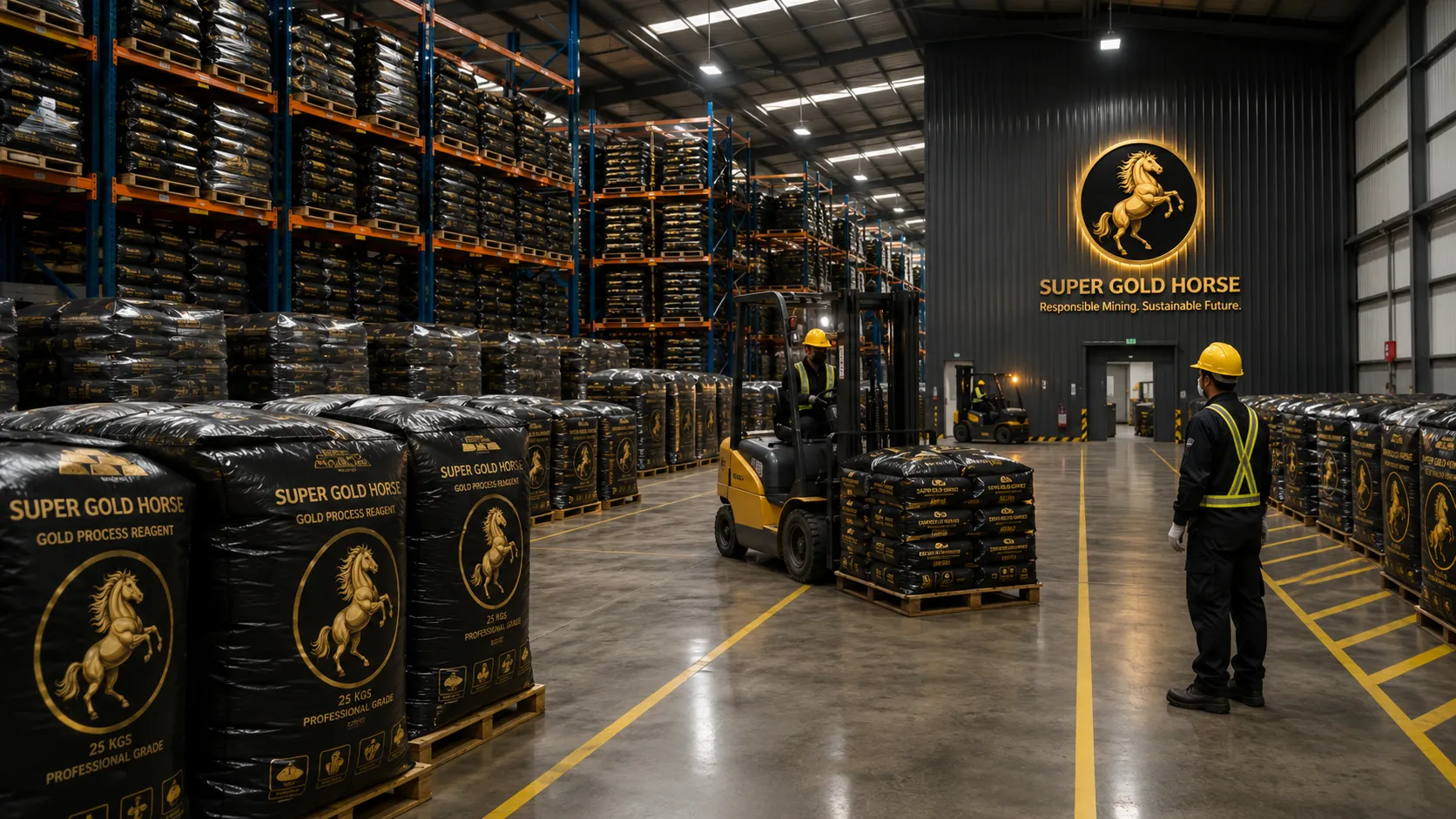
SUPER GOLD HORSE® provides a non-cyanide processing concept that can be evaluated as part of a responsible gold extraction strategy.
Rather than offering a universal process formula, its application is adapted to the mineralogical and metallurgical response of each ore body.
Ore characteristics
Controlled testing
Process evaluation
Four principles define how SUPER GOLD HORSE® is positioned within a controlled and technically informed gold processing strategy.
Designed as an alternative to conventional cyanide-based gold extraction.
Can be evaluated across different ore types and processing configurations.
Dosage and operating conditions are established through appropriate testing.
Supports the evaluation of safer and more responsible gold processing practices.
SUPER GOLD HORSE® is introduced into a controlled leaching system where the reagent interacts with gold-bearing material under defined operating conditions. The dissolved gold can then be recovered through an appropriate downstream process, including carbon adsorption.
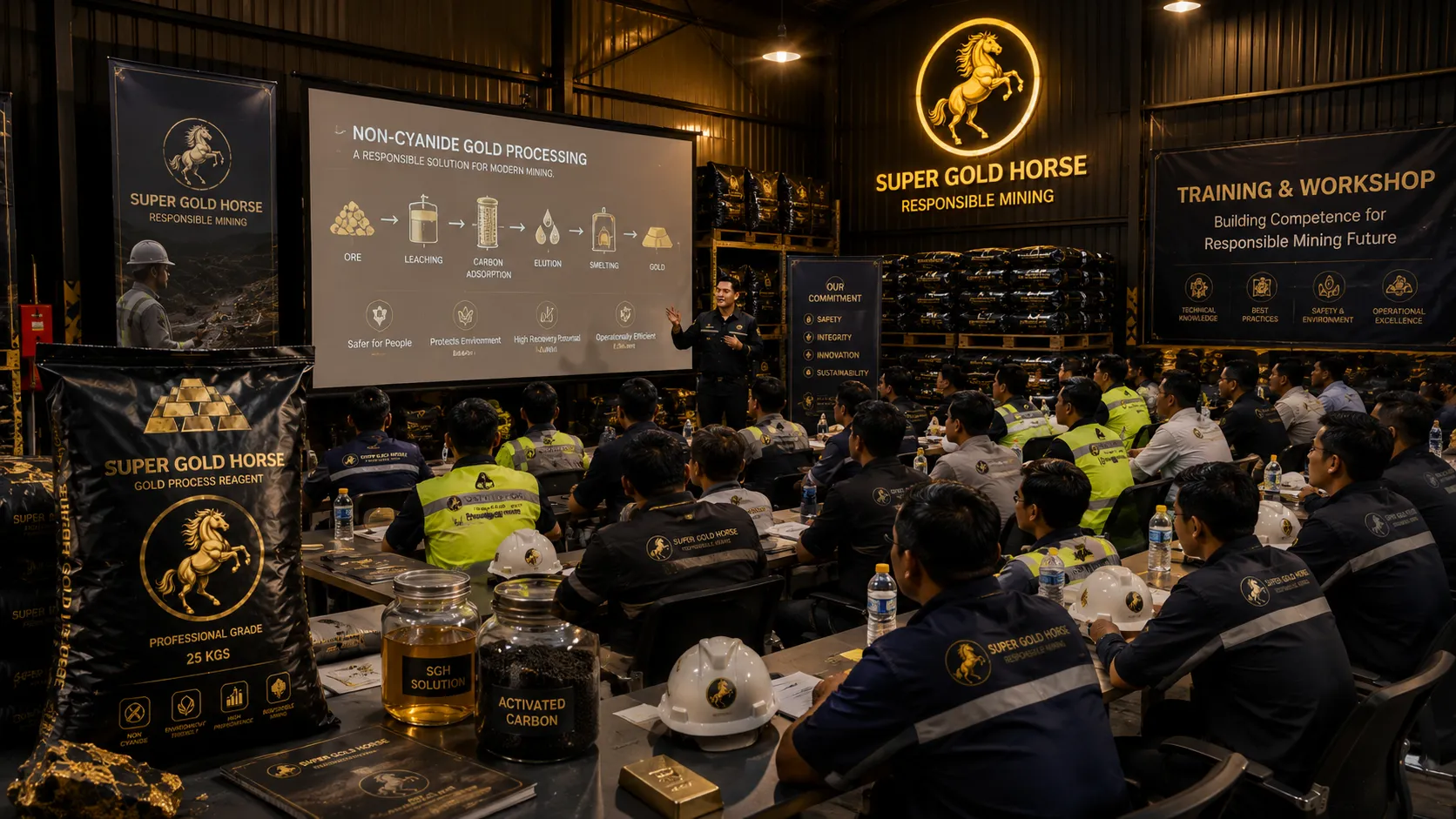
The application pathway begins with understanding the ore and continues through controlled preparation, leaching, recovery, and evaluation.
Establish operating conditions based on testing and ore response.
Monitor pH, duration, aeration, circulation, and process response.
Interpret recovery and residue data according to the conditions tested.
Each stage contributes to a technically controlled evaluation of how the reagent performs with a specific ore and processing setup.
Evaluate ore grade, mineralogy, particle size, and metallurgical response.
Prepare water, ore, pH conditions, aeration, and supporting equipment.
Add the reagent according to the dosage established during testing.
Monitor pH, duration, solution circulation, and process response.
Recover dissolved gold through carbon adsorption or another suitable system.
Analyze the resulting residue and solution according to relevant test parameters.
SUPER GOLD HORSE® can be evaluated within several processing configurations. The appropriate pathway depends on the ore characteristics, operating scale, equipment, and testing objectives.
A responsible processing decision should not be based only on gold recovery. It should also consider reagent handling, worker exposure, process stability, water management, residue characteristics, operating procedures, and site-specific environmental requirements.
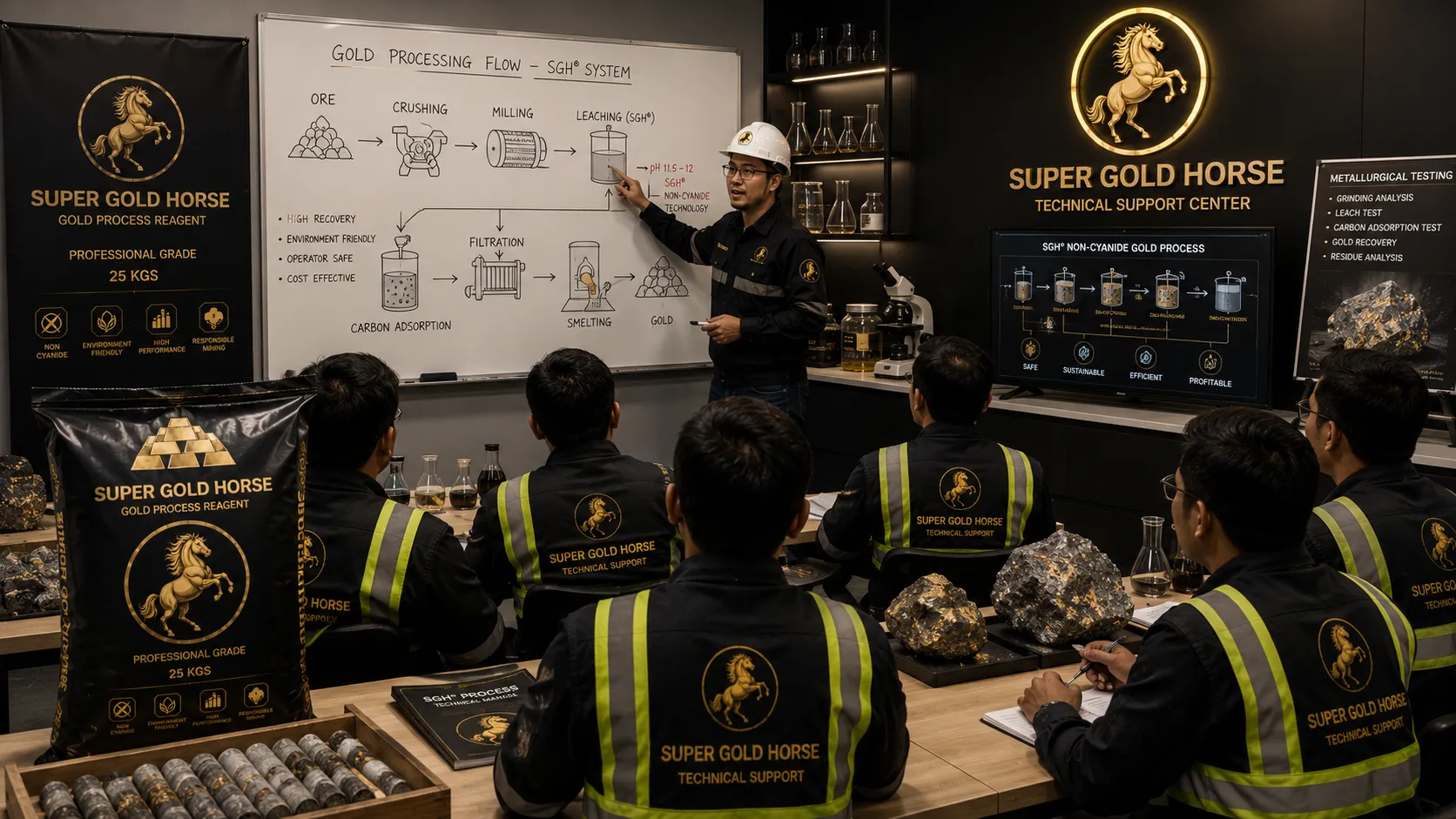
Metallurgical recovery is an important performance indicator, but it represents only one part of a processing decision. Operational suitability should be considered together with handling practices, process controls, water management, and residue characteristics.
Both dimensions should be reviewed under representative and clearly defined operating conditions.
These considerations help build a more complete understanding of reagent performance, operational suitability, and site-specific processing requirements.
Measure gold recovery according to the tested ore, methodology, and operating conditions.
Determine suitable reagent dosage and monitor consumption during the evaluated process.
Establish and maintain the pH range identified through representative testing.
Evaluate the time required to achieve the observed metallurgical response.
Monitor oxygen availability and aeration as part of the controlled leaching environment.
Assess the interaction between the gold-bearing solution and the selected carbon system.
Consider water quality, circulation, containment, reuse, and site-specific management procedures.
Analyze process residue and solution using relevant test methods and clearly defined sample conditions.
Establish training, personal protective equipment, storage, handling, and operational procedures.
Review the environmental, operational, and regulatory requirements applicable to each processing site.
SUPER GOLD HORSE® is positioned as part of a broader responsible mining approach. Final operating procedures must be based on representative testing, qualified technical evaluation, and the requirements applicable to each processing site.
Technical results should always be interpreted together with the tested sample, methodology, operating parameters, analytical scope, and applicable report limitations.
Every ore body has a different mineralogical and metallurgical response. Representative laboratory or pilot-scale testing helps determine whether SUPER GOLD HORSE® is suitable for a particular operation and identifies the operating conditions required for further evaluation.
Request a Site-Specific Metallurgical Test
A structured testing pathway helps define the appropriate scope, interpret results within the tested conditions, and identify suitable next steps.
Share ore grade, mineralogy, current processing method, production scale, and recovery objectives.
Determine the appropriate laboratory, comparative, or pilot-scale evaluation.
Evaluate reagent dosage, pH, leaching duration, aeration, carbon conditions, and recovery response.
Interpret recovery data, reagent consumption, solution behavior, and residue characteristics.
Develop appropriate recommendations for additional testing or process adjustment.
Share your current processing method, available ore data, and recovery objectives with the EcoGold technical team to begin defining an appropriate evaluation pathway.
Request a Site-Specific Metallurgical Test