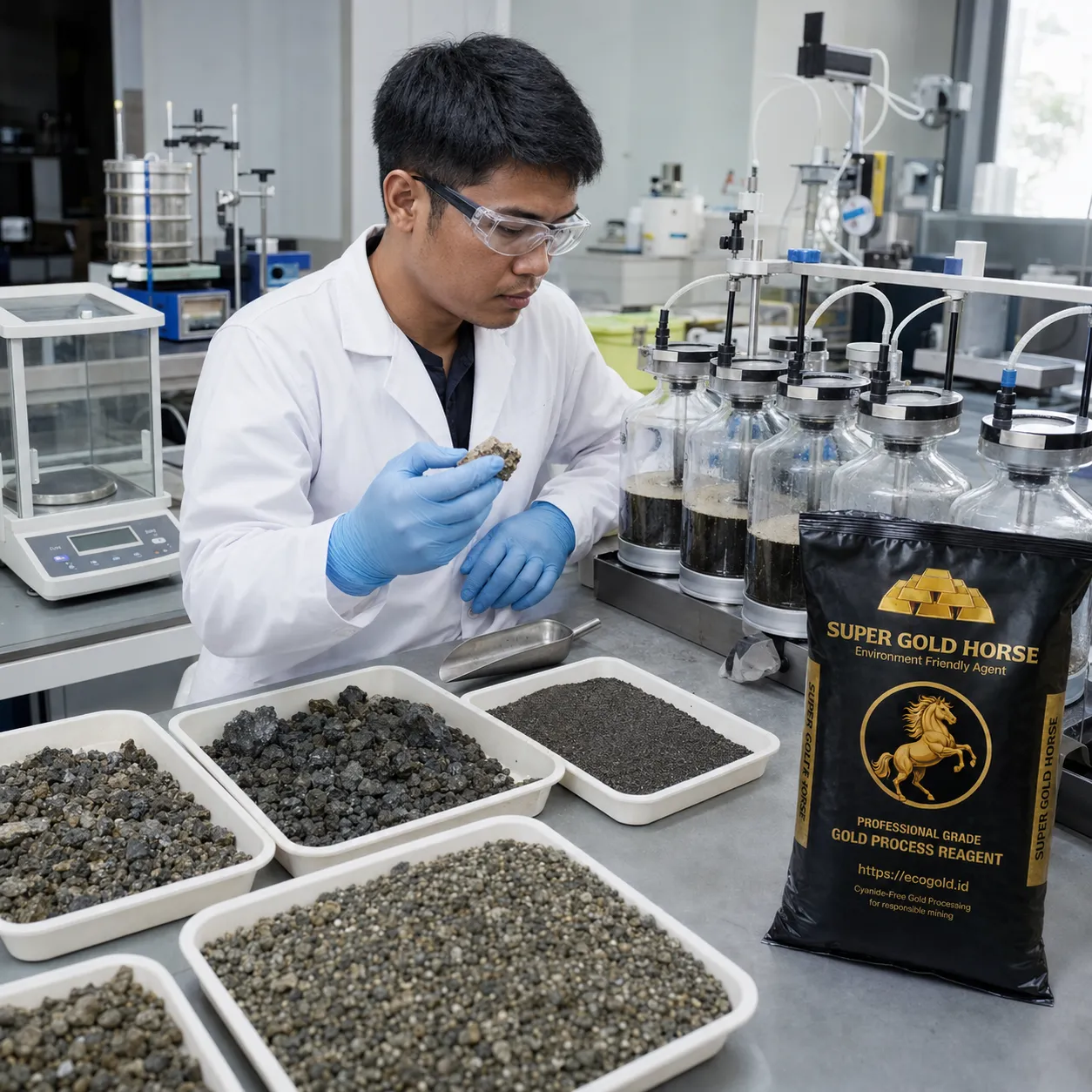
SGH® vs Sodium Cyanide in Gold Recovery
PT SUCOFINDO conducted a controlled metallurgical test using a gold ore sample and SGH® reagent provided by PT Dimar Reka Industri. The objective was to compare the gold recovery obtained using SGH® and sodium cyanide at equivalent reagent dosages.
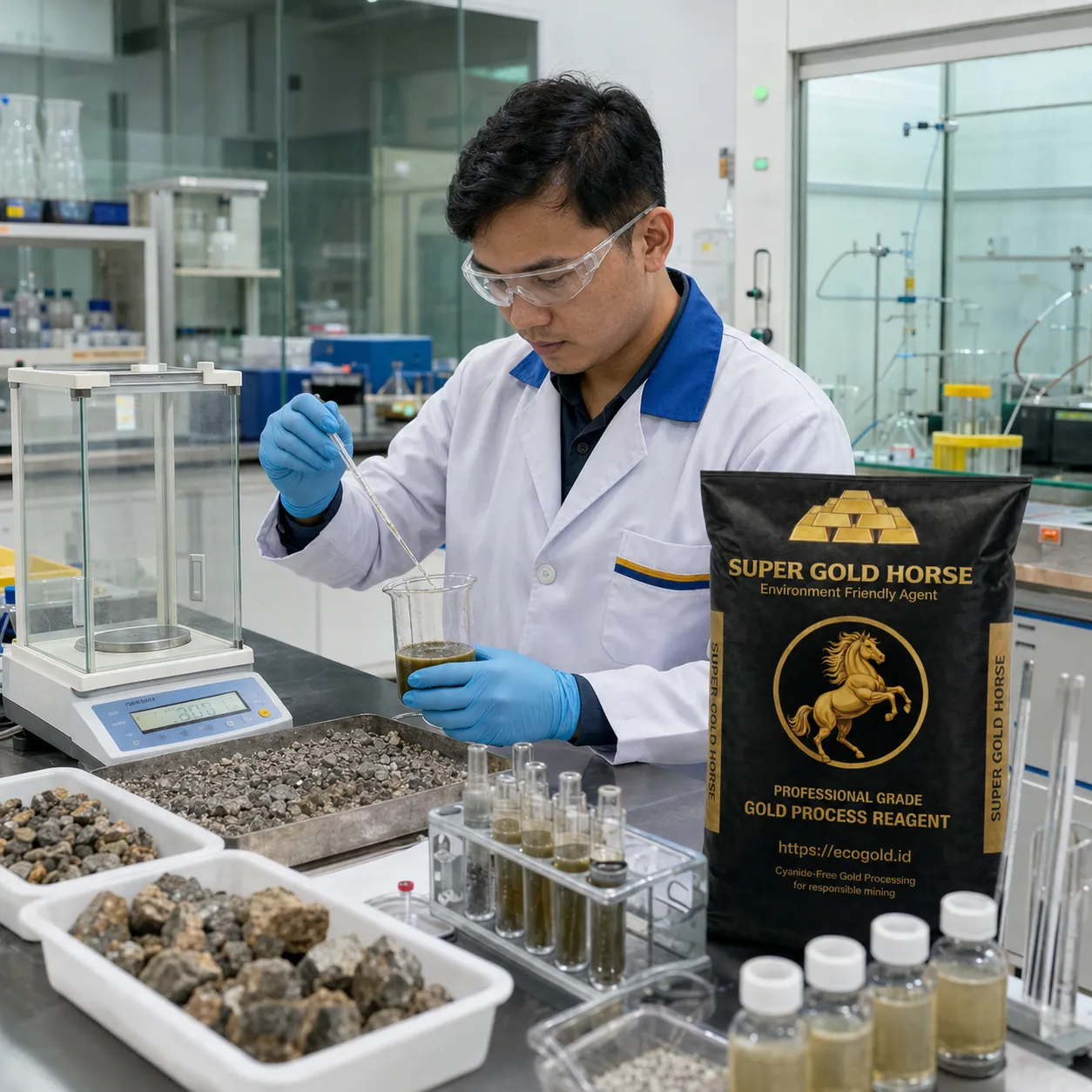
The comparative program applied controlled sample preparation, reagent dosage, leaching time, pH conditions, and analytical procedures to evaluate gold distribution and recovery.
Select a stage to review its role in the comparative test.
The ore sample was dried at 105°C, homogenized, and split into representative samples.
Both reagents were evaluated using the same feed preparation, dosage levels, and leaching duration, with their designated operating pH.
| Parameter | NaCN | SGH® |
|---|---|---|
| Ore feed | 1,100 g | 1,100 g |
| Particle size | 200 mesh P80 | 200 mesh P80 |
| Pulp density | 40% solids | 40% solids |
| Reagent dosage | 1,000 & 2,000 gpt | 1,000 & 2,000 gpt |
| Operating pH | 10.5–11.0 | 11.5–12.0 |
| Leaching duration | 48 hours | 48 hours |
| Head assay | 5.02 ppm Au | 5.02 ppm Au |
The pH ranges shown above are the designated laboratory conditions reported for each reagent.
Separate process streams were analyzed to determine gold content, distribution, and calculated recovery.
Fire assay followed by AAS
Atomic Absorption Spectroscopy (AAS)
Fire assay followed by AAS
Select a reagent dosage to compare measured gold recovery, residual gold, and solution gold under the reported laboratory conditions.
| Reagent | Dosage | Recovery | Residual Au | Solution Au |
|---|---|---|---|---|
| NaCN | 1,000 gpt | 72.95% | 1.46 ppm | 0.02 ppm |
| SGH® | 1,000 gpt | 69.65% | 1.66 ppm | 0.01 ppm |
| NaCN | 2,000 gpt | 75.64% | 1.28 ppm | 0.01 ppm |
| SGH® | 2,000 gpt | 71.74% | 1.56 ppm | 0.01 ppm |
Test context: Results shown are measurements reported for the specific ore sample and controlled CIL laboratory conditions described in the metallurgical test report.
A measured interpretation of the reported recovery data, analytical procedures, and principal findings under the tested conditions.
Under the laboratory conditions applied to this specific ore sample, both reagents produced relatively comparable gold recovery results. SGH® achieved recoveries of 69.65% at 1,000 gpt and 71.74% at 2,000 gpt.
At equivalent dosage levels, the measured difference between SGH® and sodium cyanide ranged from 3.30 to 3.90 percentage points. Increasing the SGH® dosage from 1,000 to 2,000 gpt improved measured recovery by 2.09 percentage points.
These observations describe the specific ore sample and laboratory parameters reported in the comparative test. Metallurgical response may vary with ore characteristics and operating conditions.
Summary of the principal measurements and process observations reported under the tested conditions.
Measured by fire assay followed by AAS.
Recorded at a dosage of 2,000 gpt.
Measured at the 1,000 gpt dosage level.
Higher dosage improved measured recovery for both reagents.
Activated carbon contained most of the recovered gold after the CIL test.
Gold content was measured across the main CIL sample streams to support distribution and recovery calculations.
| Sample Stream | Parameter | Analytical Procedure |
|---|---|---|
| 01Head assay | Au | Fire assay followed by AAS |
| 02Leach residue | Au | Fire assay followed by AAS |
| 03Pregnant leach solution | Au | AAS |
| 04Activated carbon | Au | Fire assay followed by AAS |
Metallurgical performance varies between ore bodies. Mineralogy, particle size, head grade, pH, reagent dosage, oxygen availability, leaching time, carbon activity, and the presence of interfering minerals may influence the final recovery.
For this reason, laboratory or pilot-scale testing using representative ore samples is recommended before determining full-scale operating parameters.
Begin a technical evaluationRequest a Site-Specific Metallurgical TestThe following boundaries help ensure the metallurgical data is interpreted in its proper technical context.
The results apply to the ore sample and laboratory test conditions described in the report.
The test evaluates measured gold recovery within a controlled Carbon-in-Leach process.
This metallurgical test does not evaluate toxicity, TCLP characteristics, worker safety, or environmental impacts. Those subjects require separate supporting test data and documentation.
Laboratory-scale results do not automatically guarantee equivalent recovery in full-scale commercial operations.
Process parameters should be adjusted to the mineralogy and operating characteristics of each site.